🌡️ Soil Temperature

Know Exactly When to Apply Pre-Emergent

Real-time soil temps by ZIP code with 3-day and 7-day averages. Never miss the prodiamine window.

Look Up Your ZIP ↓
🏠 All 🧮 Calculators 📖 Lawn Care 101 📅 Seasonal 👤 About

Look Up Your Soil Temperature

Uses real-time data from Open-Meteo (NOAA/ERA5 models) — no account required.

Understanding Prodiamine Timing

The soil temperature thresholds that separate a clean lawn from a crabgrass disaster.

❄️ Below 45°F (3-day avg)
Soil is still cold. No crabgrass risk yet. Hold off — applying now means the product degrades before peak germination.
👀 45–50°F (3-day avg)
Watch window. Temps are climbing. Monitor daily. You're 1–2 weeks out in most Midwest climates.
🎯 50–55°F (3-day avg)
Apply now. This is the sweet spot. Crabgrass germination is imminent. Get prodiamine down before a warm rain.
🔴 Above 55°F (3-day avg)
Germination may have started. Apply immediately if you haven't. Consider a split app or higher rate to salvage the window.
Pro tip: The 3-day average is your trigger signal — it smooths out cold snaps and warm spikes. The 7-day average tells you the trend. If both are climbing together, it's time to act. Check back daily once you hit 45°F.
New to Pre-Emergent? Read This First.

Not sure what pre-emergent actually does, or why soil temperature matters more than the calendar? The crabgrass guide explains everything from scratch — what crabgrass is, how the window works, and what happens if you miss it.

Read the Crabgrass Guide →
🌱
Gear & Tips
What You'll Need When the Window Opens
My Pre-Emergent Pick
Top Pick
Anderson's Barricade with 0.48% Prodiamine (40 lb bag)
“The pre-emergent I switched to and never looked back. Higher prodiamine concentration, better coverage, season-long control.”
  • Professional-grade weed control for early spring and fall applications
  • Contains 0.48% of the active ingredient prodiamine
  • Prevents 30 grass and broadleaf weeds, including crabgrass, poa annua, goosegrass, henbit, and more
  • Made with patented DG Technology (dispersible granule) — granules dissolve rapidly upon watering, moving weed control directly into the soil for maximum impact
  • Small particles for more coverage per square inch and superior performance
  • Designed to prevent weeds; will not eliminate existing weeds
Check Price & Availability →
Affiliate link — I earn a small commission at no extra cost to you. I only recommend products I personally use.
My Spring Fertilizer Pick
Top Pick
Anderson's CORE 12-8-12 All-Season Lawn Fertilizer
“Once your pre-emergent is down, CORE 12-8-12 is my go-to for the spring feeding. The Ammonium Sulfate nitrogen is fast-acting — you'll see green in days, not weeks.”
  • Apply 1–2 weeks after pre-emergent for a powerful spring one-two punch
  • Nitrogen from Ammonium Sulfate — fast-acting, greens up your lawn within days of watering in
  • Slightly acidic — helps lower soil pH over time, which most cool-season grasses prefer
  • Balanced 12-8-12 N-P-K formula with micronutrients + 2% iron for deep, rich color
  • Ultra-fine particle size — 60% smaller than standard consumer granules for more even coverage
  • Feeds for up to 6 weeks — reapply every 4–6 weeks during the growing season
Check Price & Availability →
Affiliate link — I earn a small commission at no extra cost to you. I only recommend products I personally use.
My Spreader Pick
Top Pick
ECHO RB-60 Heavy-Duty Broadcast Spreader
“The spreader I use on my own lawn — nothing else comes close.”
  • 60 lb hopper — covers up to 25,000 sq ft per load
  • Factory-calibrated spread pattern up to 8 ft wide
  • Maintenance-free gear case — no grease, no hassle
  • Foot-operated side deflector keeps product off driveways & beds
  • 10" pneumatic tires handle any terrain with ease
  • Powder-coated steel frame — 5-year consumer warranty
Check Price & Availability →
Affiliate link — I earn a small commission at no extra cost to you. I only recommend gear I personally use.

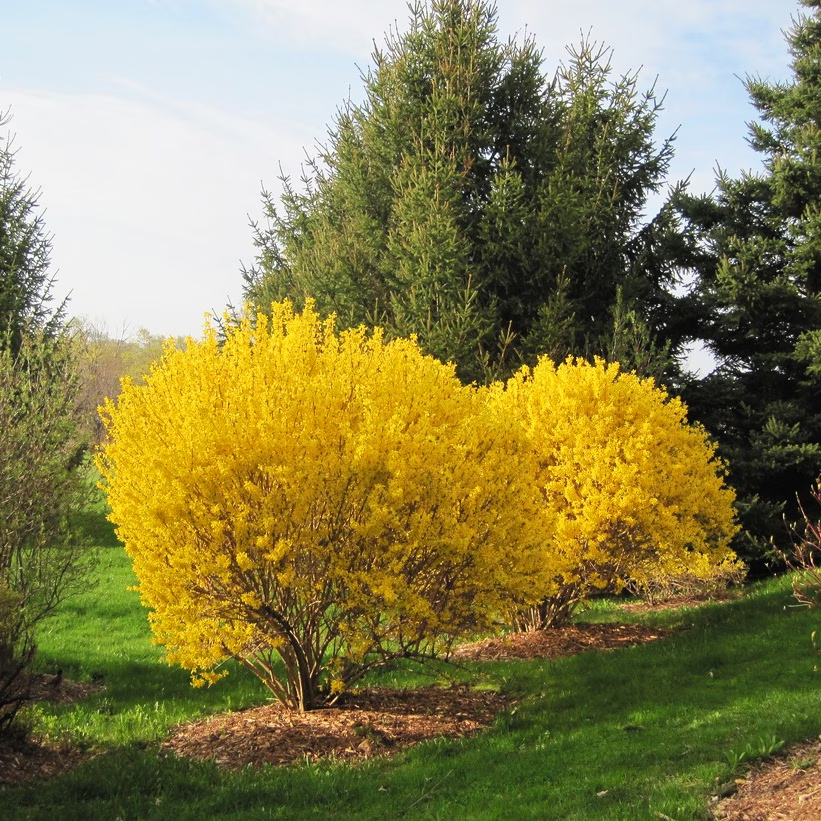
Forsythia Trick

Forsythia bush in full bloom with bright yellow flowers in early spring

Old-school landscapers use forsythia as a natural soil temp indicator — when you see those bright yellow blooms, soil temps are approaching 50°F. Not precise, but a reliable Midwest rule of thumb. If your forsythia is popping, start checking your soil temps daily.